HD vs Airbrush Makeup: Which One Is Right for Your Wedding Day?
You've booked the venue, picked the lehenga, and now your makeup artist asks the big question: HD or airbrush? If you're nodding politely while quietly panicking, you're not alone. Both can give you a stunning bridal look. The right choice depends on your skin, your weather, your outfit, and how you want to feel through a long wedding day. Let's break it down in simple words.
Quick answer
- Choose airbrush for a lightweight, natural, long-lasting finish, especially for a summer or outdoor wedding.
- Choose HD if you love a bold, defined look, want more shade choices, or have a tighter budget.
- Still unsure? Let a trial decide. Skill matters more than the label.
What Is HD Makeup?
HD makeup uses regular liquid or cream products, applied with brushes and sponges. It's called HD because the formulas are made to look smooth and natural in high-definition cameras, with no cakey patches or visible lines.
Pros
- Wider range of shades, which helps a lot for Indian skin tones
- More budget-friendly in most cities
- Gives a rich, glam finish with strong coverage
- Easy to touch up during the day
Cons
- Can feel heavier on the skin
- May look thick if the artist overdoes the layers
- Can melt faster in heat and humidity, depending on skin prep and products
What Is Airbrush Makeup?
Airbrush makeup is sprayed onto the skin using a small tool connected to an air compressor. The product comes out as a fine mist, which settles in thin, even layers.
Pros
- Feels light and looks like real skin
- Smooth, flawless finish that photographs beautifully
- Usually lasts longer, even through long ceremonies and warm weather
- Great for covering pigmentation, redness, and uneven texture without looking heavy
Cons
- Costs more than HD in most places
- Fewer artists have proper training, so choose carefully
- Touch-ups can be trickier, so you may need to carry the same product
- Not ideal if you want a very bold, high-coverage look
HD vs Airbrush at a Glance
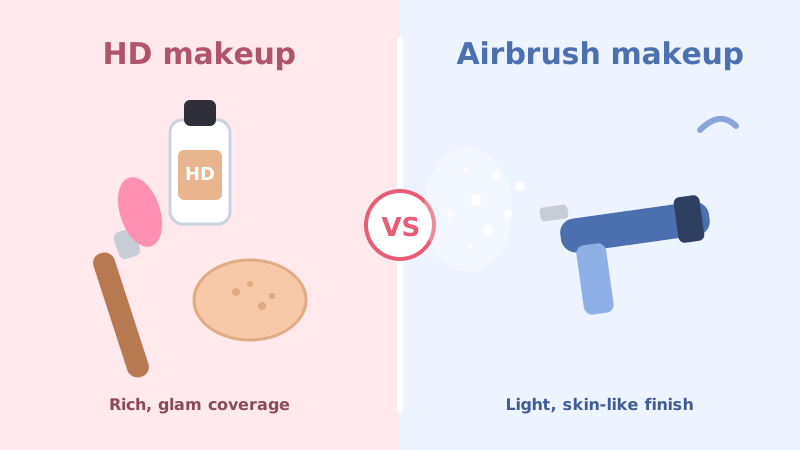
| HD makeup | Airbrush makeup | |
|---|---|---|
| Feel | Can feel heavier | Feels light |
| Finish | Glam, defined look | Soft, skin-like finish |
| Staying power | Depends heavily on prep | Generally holds better in heat |
| Budget | Easier on the pocket | Costs more |
| Best for | Brides who like a classic bold look | Brides who want a natural, lightweight look |
Things Every Bride Should Keep in Mind Before Choosing
- Your skin type. Oily skin needs a long-wear, matte-friendly base. Dry skin needs hydration so makeup doesn't flake.
- Weather and venue. A summer wedding or an outdoor mandap is tough on makeup. Airbrush often handles it better.
- Number of events. If you're doing makeup for sangeet, haldi, and wedding, discuss packages and skin comfort.
- Your comfort. Think about how you feel in makeup. If you hate a heavy face, airbrush may suit you better.
- Your outfit and jewellery. Heavy red lehengas, gold jewellery, and bold lips need a base that supports the look.
- Photography and lighting. Flash and strong lights can show every patch, so ask your artist to test in similar conditions.
- Your artist's experience. A great artist with HD can beat an average artist with airbrush. Skill matters more than the label.
- Skin sensitivities. Share allergies or reactions with your artist before the trial.
Choosing According to Indian Skin Tones
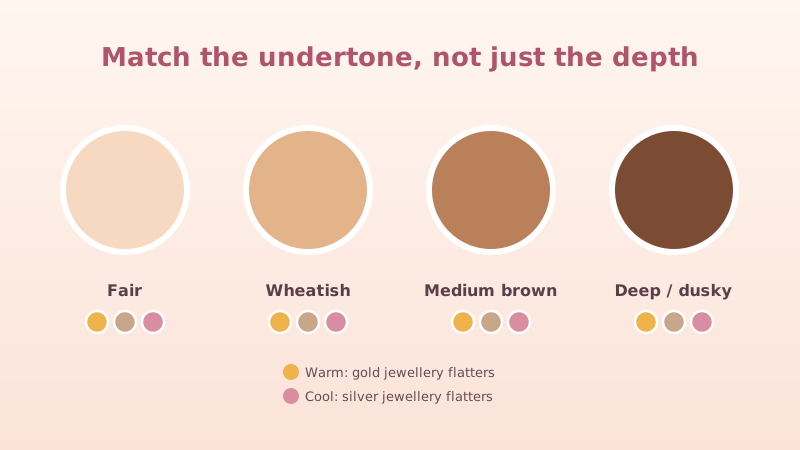
Indian skin comes in a beautiful range of shades and undertones. The most important thing is matching your undertone, not just how fair or deep you are. Undertones are usually warm (golden or yellow), neutral, or cool (pink or bluish). A quick check: if gold jewellery flatters you more, you may be warm. If silver looks better, you may be cool.
Fair skin
Fair skin can show redness and veins easily. Both HD and airbrush work well. Choose a foundation with a neutral or slightly peachy undertone, and avoid shades that turn pink or grey in photos.
Wheatish skin
This is the most common Indian skin tone, and usually has warm or golden undertones. Airbrush gives a lovely glow, while HD can add definition. Avoid foundations that are too light, because they create a white cast in pictures.
Medium brown skin
Look for foundations with golden or olive undertones, and ask your artist to use color correctors for dark circles or pigmentation, such as peach or orange tones. Both techniques work well. The key is shade matching in daylight.
Deep or dusky skin
Deep skin deserves rich, true shades, not lightened ones. Ask your artist to mix shades if needed, and avoid anything that looks ashy. Be careful with powders and heavy SPF, which can leave a grey cast in flash photography. HD offers more shade options in many kits, while airbrush can look incredibly smooth when the shade is perfect.
A few tips for all skin tones
- Always match foundation to your neck and chest, not just your face.
- Check the shade in natural daylight, not only under salon lights.
- Ask your artist about flashback, which is the white cast that shows up in photos with flash.
- Choose blush, lipstick, and highlighter that suit your undertone, so you glow instead of looking washed out.
Makeup Trials: Don't Skip Them
A trial is your chance to see exactly how you'll look and feel before the big day. It's also a good way to see whether you and your artist are on the same page.
How to prepare
- Book the trial two to four weeks before the wedding, so there's time to make changes.
- Come with clean, moisturised skin and no heavy products.
- Bring photos of looks you like and ones you don't.
- Wear a similar color to your wedding outfit, or carry the dupatta or blouse.
- Do a patch test beforehand if you have sensitive skin.
What to check during the trial
- Take photos in daylight, indoor light, and with flash.
- Check how the base feels after a few hours. Is it itchy, heavy, or patchy?
- See how your lips, eyes, and base last through eating, talking, and laughing.
- Try your hairstyle and jewellery with it, if possible.
- Ask for adjustments, and take notes on exact products and shades.
Try both if you can
If you're torn, do a trial with HD and another with airbrush, or ask your artist to do each side of your face. Seeing the difference on your own skin is better than any online opinion.
Extra Tips for a Smooth Makeup Day
- Start a simple skincare routine at least a month before: cleanse, moisturise, and use sunscreen.
- Avoid trying new facials, peels, or products in the last week.
- Drink plenty of water and sleep well the night before.
- Eat before the makeup session, so you don't feel faint.
- Carry a small touch-up kit: blotting paper, lipstick, compact, and the same foundation shade.
- Wear a front-button or loose top so you don't smudge your base while changing.
- Be honest with your artist about what you like and don't like.
- Book your artist early, especially during wedding season. You can browse bridal makeup artists on Konnect Dots, look through their work, and send an enquiry.
So, Which One Should You Choose?
Choose airbrush if you want a lightweight, natural, long-lasting finish, especially for a summer or outdoor wedding. Choose HD if you love a bold, defined look, want more shade choices, or have a tighter budget. And if you're still unsure, let the trial decide. The best makeup is the one that makes you feel like the best version of yourself, comfortable and confident, from the first ritual to the last photo.
The pictures in this guide are illustrations made for Konnect Dots, shown to explain each idea. They are not photographs of a real event.